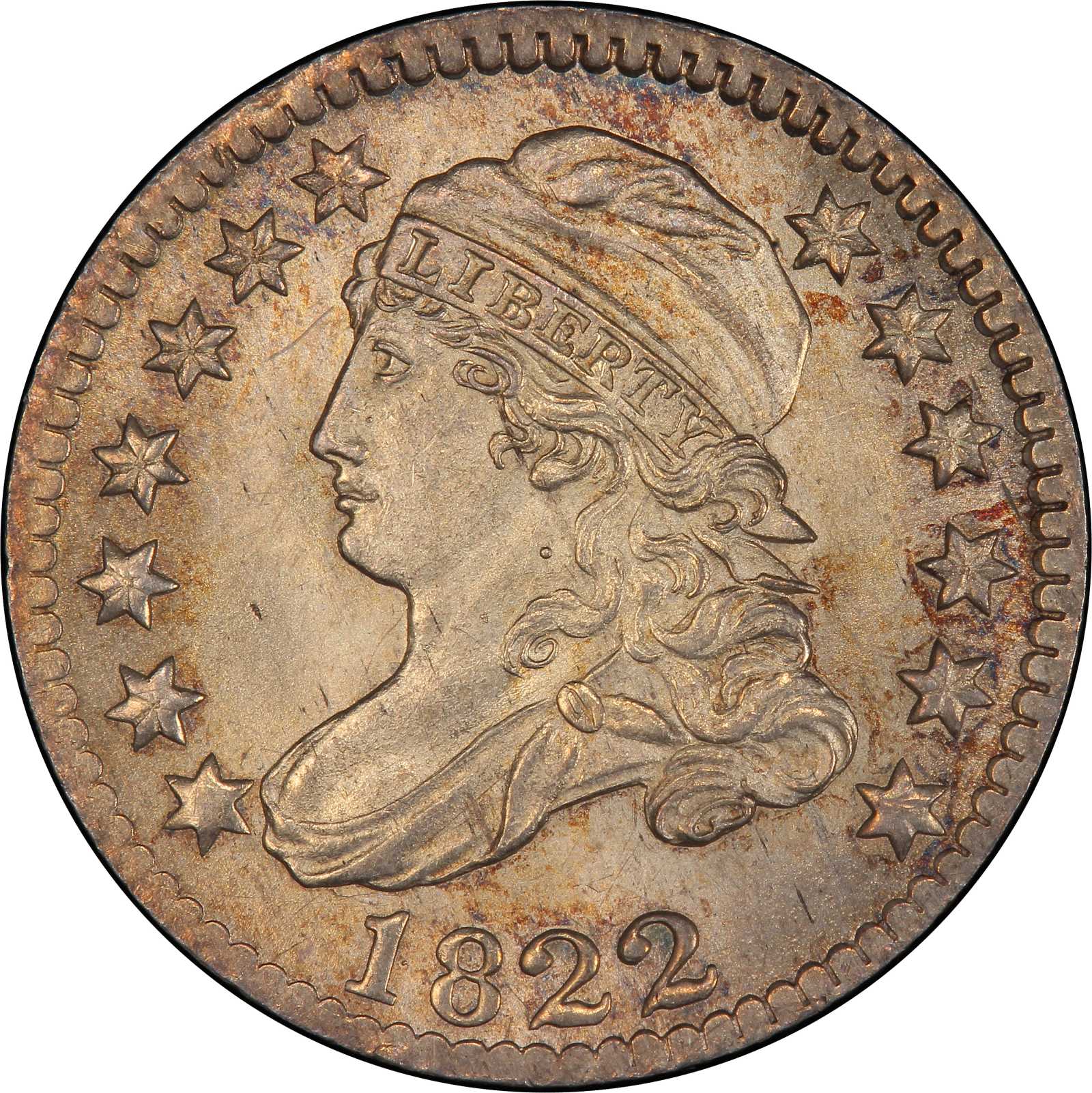
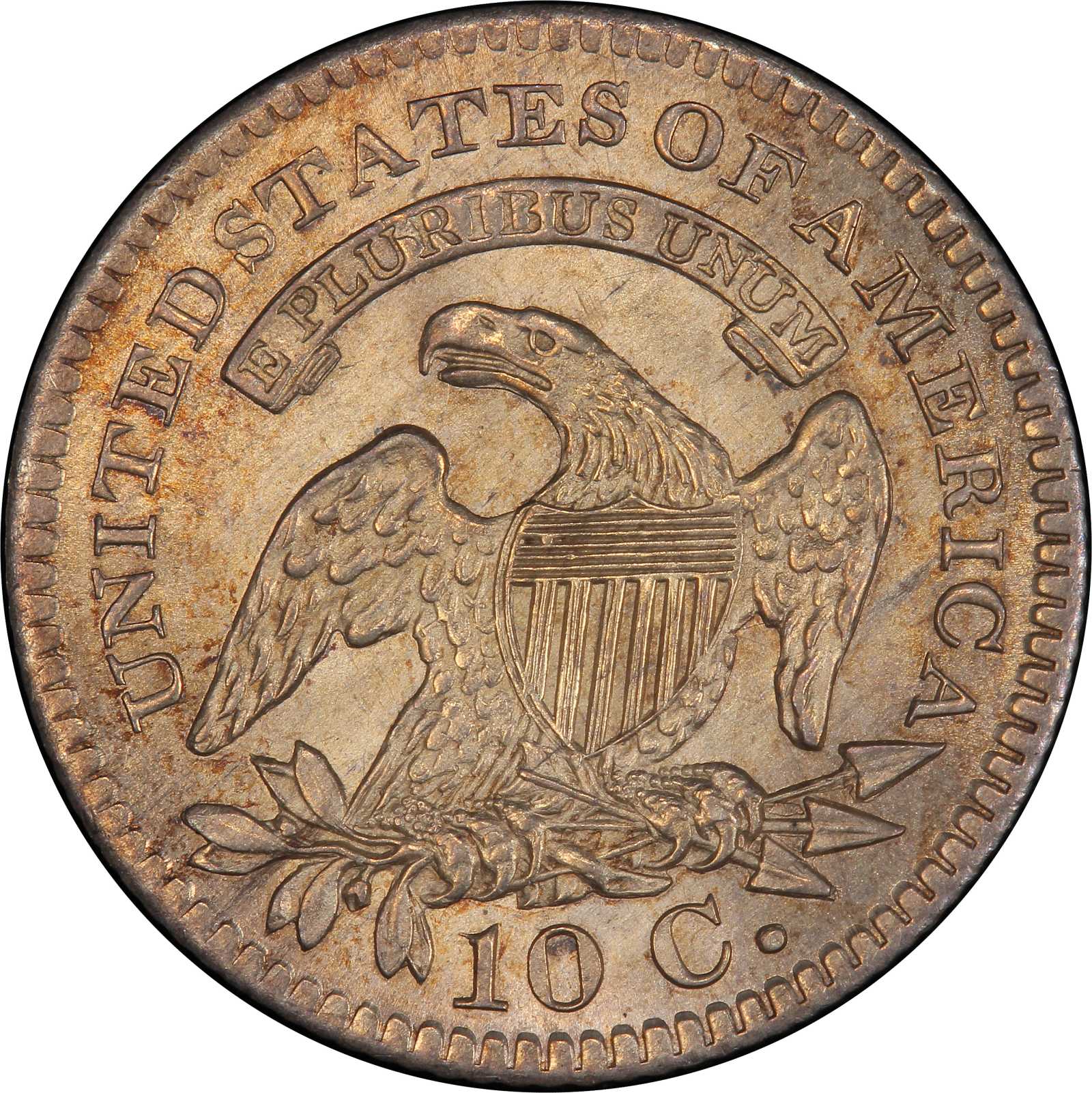
The Capped Bust dime, engraved by John Reich, debuted in 1809 — the second denomination to adopt the design after the half dollar. The obverse shows Liberty wearing a cloth cap; the reverse depicts an eagle perched on a branch and arrows. No dimes were dated 1808, and coinage during this era was not continuous, with several gaps among the early years.
Key facts
- Designed by: John Reich
- Issue dates: 1809–1837
- Composition: 89.24% silver, 10.76% copper
- Diameter: ~18.8 mm (varies by era)
- Edge: Reeded
The series splits into two types. The Large Size type (1809–1827) was struck with an open collar, giving a wider border and slightly larger diameter; starting in 1828 a Small Size closed-collar type (1828–1837) produced a sharper border and a slightly smaller, more uniform diameter. Both are collected for a type set.
Dimes of this era were made in relatively small quantities and are much harder to find today than contemporary large cents. Numerous overdates and die varieties exist (1811/09, 1823/2, 1824/2, 1830/29, and the 1828 Large Date Curl Base 2 vs. Small Date Square Base 2, among others). The key early date is the 1822; among the later dates, the 1829 Curl Base 2 is the rarity. Aside from those, most dates and varieties are reasonably available.
We actively buy Capped Bust dimes in every grade, from well-worn type coins to key dates and scarce die varieties. Send photos for a free, no-obligation offer.