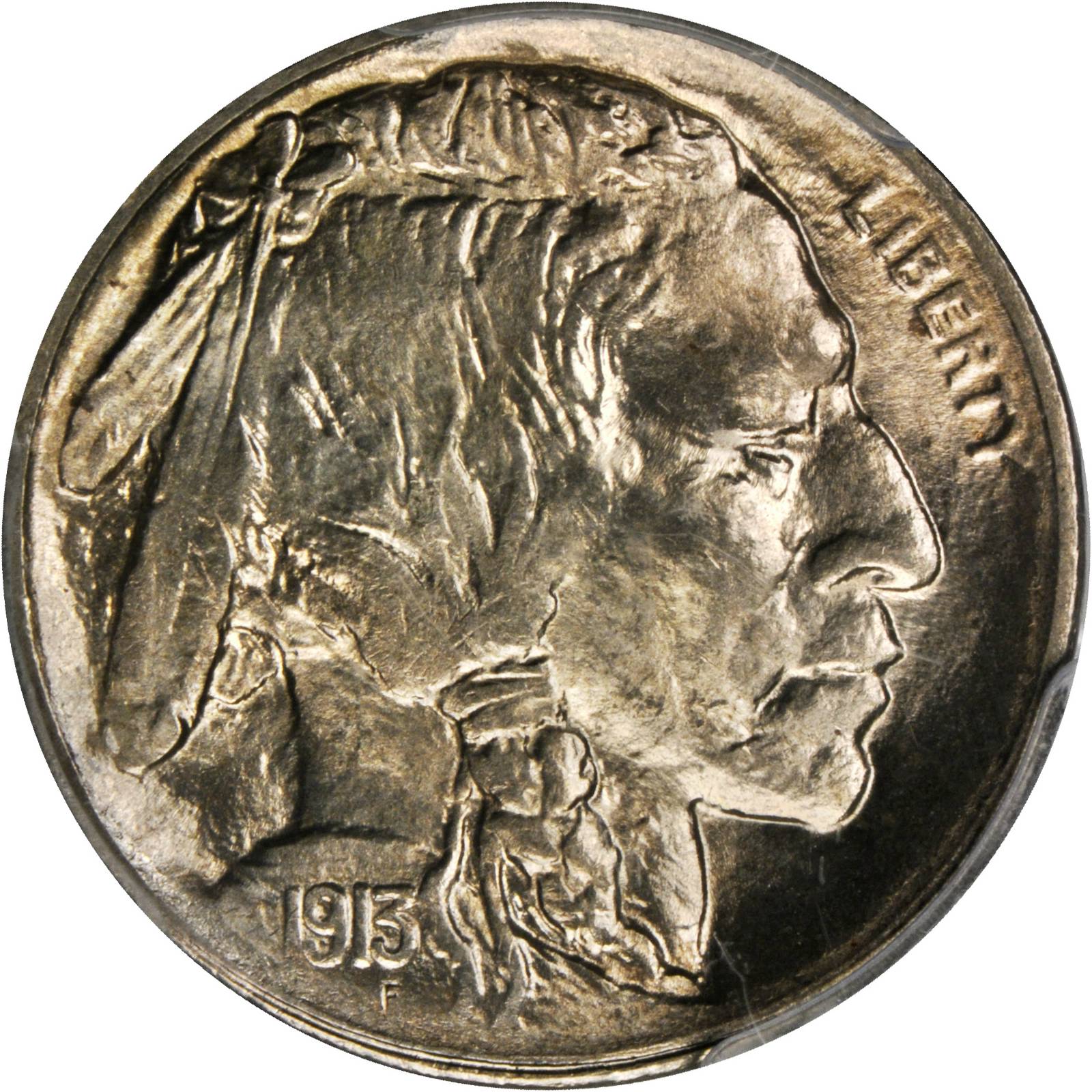
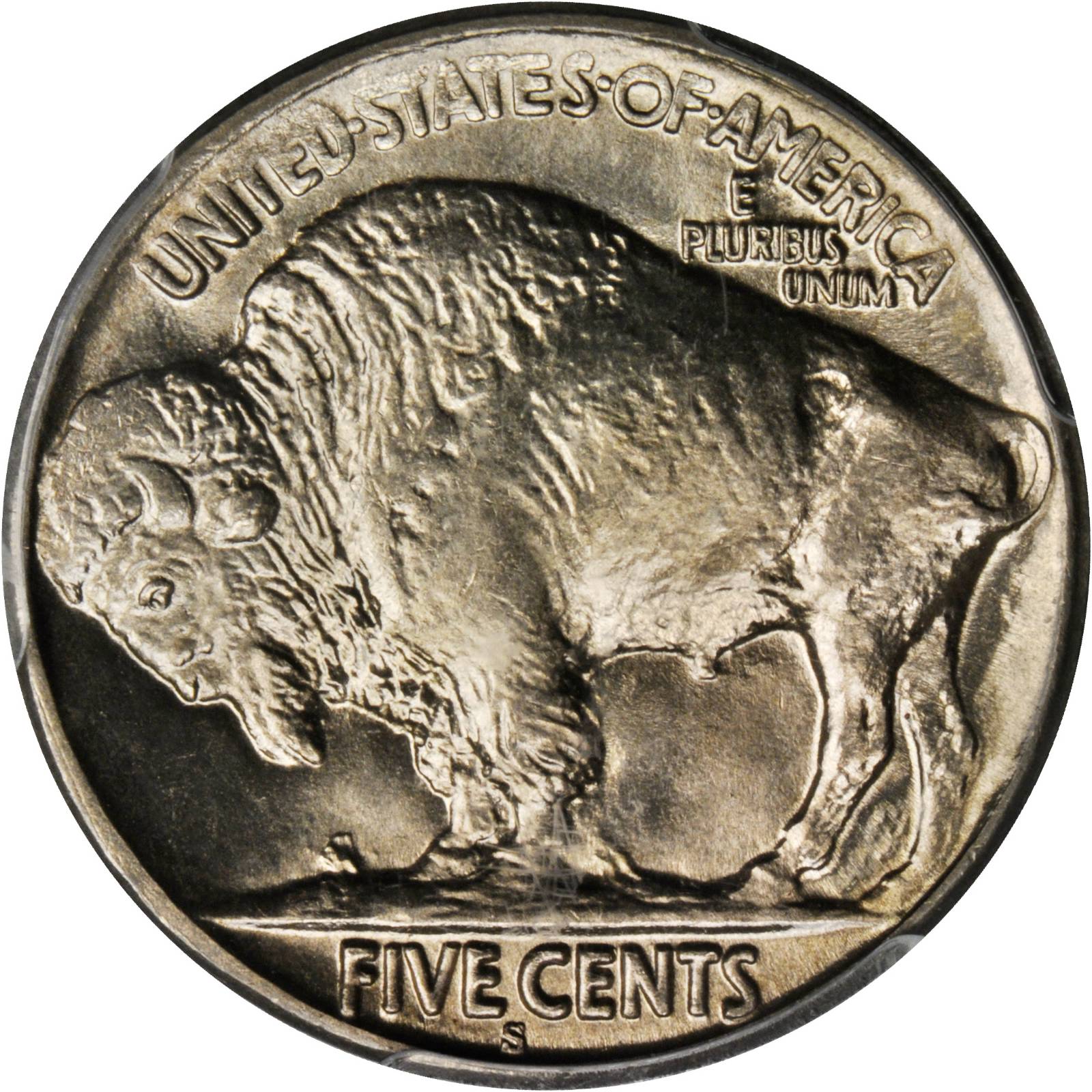
The Buffalo nickel — also called the Indian Head nickel — was designed by sculptor James Earle Fraser and struck from 1913 through 1938. The obverse bears a composite portrait of a Native American; the reverse shows an American bison modeled on “Black Diamond.” With almost no flat field on either side, the coin looks more sculpted than struck, and it is widely regarded as one of the most distinctly American designs ever used in circulation.
Key facts
- Designed by: James Earle Fraser
- Issue dates: 1913–1938
- Composition: 75% copper, 25% nickel
- Diameter: 21.2 mm
- Weight: 5 grams
- Edge: Plain
The series has two design types, both needed for a type set. The Type I (1913) shows the bison on a raised mound with FIVE CENTS in high relief; because that lettering wore quickly, the design was revised later in 1913 to Type II, with the bison on a flat plain and the denomination recessed. The date was also on a high point and wore away in circulation, so many well-worn Buffalo nickels are “dateless.”
The hard alloy and high relief made full strikes difficult, so sharply detailed coins — especially Denver and San Francisco issues of 1914–1931 — are the exception; the 1926-D is famously weak. Key dates and varieties include the 1913-S Type II, the 1918/7-D overdate (the only overdate in the series), the celebrated 1937-D “Three-Legged” (a ground-down die left the bison missing a foreleg), and the 1938-D/S over-mintmark. Beware added-mintmark and plated fakes; certified coins are the safe way to buy the key dates.
We actively buy Buffalo nickels in every grade, from dateless common coins to key dates, overdates, and sharp Mint State and Proof examples. Send photos for a free, no-obligation offer.